
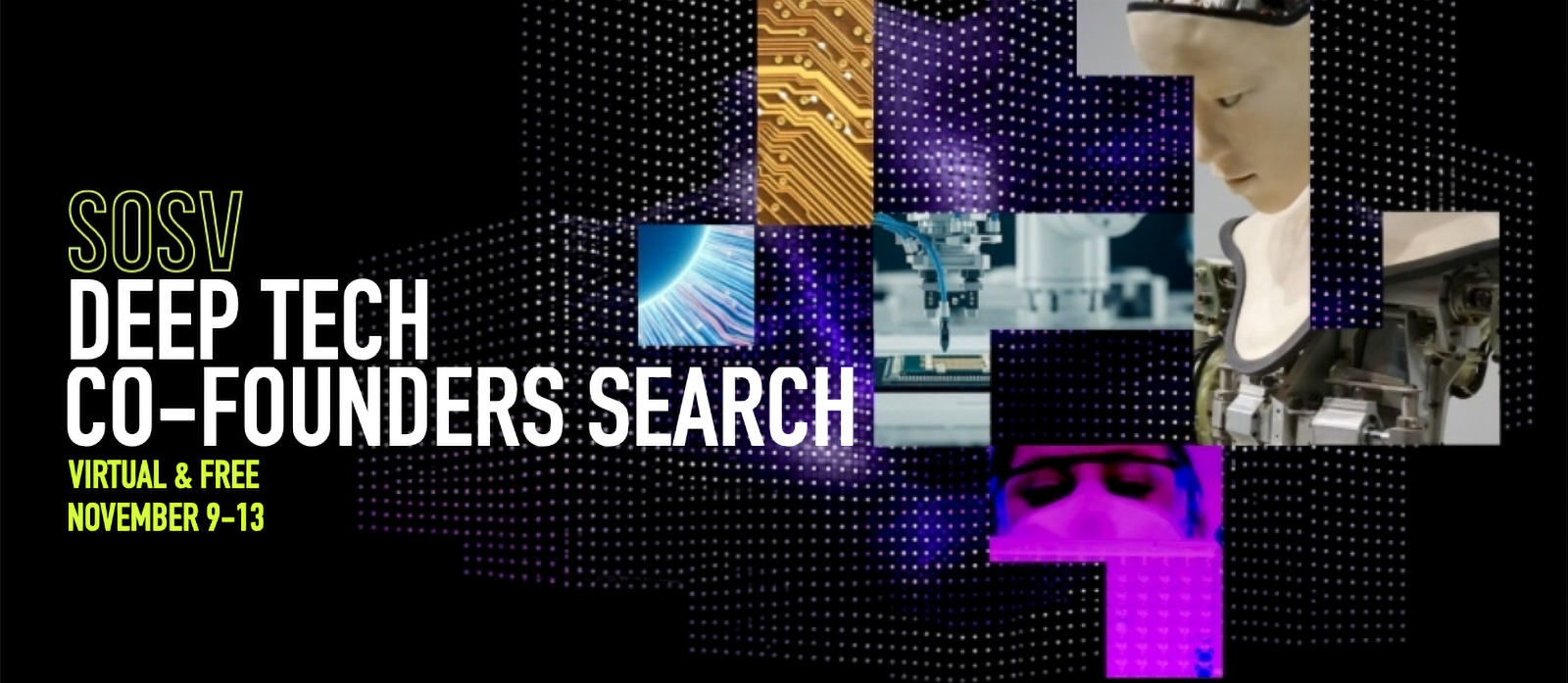
SOSV is launching the 2026 Deep Tech Co-Founder Search, a virtual event designed to connect people building deep tech startups with talented scientists, engineers, operators, and entrepreneurs interested in joining them as co-founders.
You can participate with or without an existing project.
Founders with a project will be able to discover potential co-founders based on their expertise, experience, interests, location, and availability. Participants looking for a startup to join will be able to discover projects and founding teams aligned with their skills and interests.
The event is open across deep tech, including AI and advanced computing, robotics, biotech, therapeutics, medical devices, energy, climate and environmental technologies, materials, advanced manufacturing, semiconductors, aerospace, space, agriculture, food, mobility, and more.
The goal is simple: make it easier for exceptional people who should be building companies together to find each other.
Who should attend?
If you already have a project:
You might be a solo founder looking for a technical or business co-founder, a scientist commercializing research, or an existing founding team looking for an additional co-founder with complementary expertise.
If you don’t have a project:
You might be a scientist, engineer, operator, product leader, commercial executive, or experienced entrepreneur interested in finding the right deep tech project and people to build with.
You do not need to be affiliated with SOSV or an SOSV portfolio company to participate.
How does it work?
- Register – Create a profile describing yourself, your experience and what you are looking for. If you have a project, tell us about the project and the type of co-founder you need.
- Request Meetings – From November 2, participants will receive access to the Grip platform, where they can browse profiles and request meetings with people or projects they would like to explore.
- Connect – From November 9, double opt-in meetings can take place at mutually convenient times.
The event is completely free to participate in.
Finding a co-founder is a much bigger decision than finding an investor, employee, or business partner. We don’t expect an algorithm or a short meeting to make that decision for you. The purpose of the Deep Tech Co-Founder Search is simply to help the right people find each other and start the conversation.
Have a project and looking for a co-founder?
Looking for the right deep tech startup to co-found?
Note: There is a limit of 20 pending meeting requests you can send. You can cancel requests to get them back.
FAQs
Q: Why is SOSV doing this?
- SOSV is a leader in deep tech investing with hundreds of portfolio companies. You can explore them in the Deep Tech 100.
- We believe great companies start with great people. Helping talented founders, scientists, engineers and operators find each other strengthens the deep tech ecosystem, and creates more opportunities for ambitious companies to get started.
Q: What is the duration of meetings?
- Meetings are 20 minutes, with the option to continue the conversation afterward.
- Meetings start on the hour or half-hour, leaving a 10-minute buffer between slots.
Q: Can I connect outside the Grip platform?
- Yes. Participants can also use Calendly or an equivalent service to arrange meetings via Zoom, Teams, Meet, etc.
- All participants provide a LinkedIn profile, so you can also connect there.
Q: What can I expect as a founder?
- You’ll be able to discover prospective co-founders, including information about their education, work experience, expertise, location, interests and availability.
- Getting meetings is not guaranteed. The best approach is to start early, identify people whose background genuinely fits what you need, and send targeted meeting requests explaining why you think there could be a fit.
Q: What can I expect as a prospective co-founder?
- You’ll be able to discover deep tech projects and founding teams across a wide range of sectors and stages, with information about what they are building, their progress, their existing team, and the kind of co-founder they are seeking.
- We recommend investing time in identifying the projects and people that genuinely interest you and reaching out proactively.
Q: Does SOSV recommend or endorse participants?
- No. SOSV facilitates discovery and introductions but does not verify or endorse participants or the information they provide.
- Choosing a co-founder is a major decision, and participants should conduct their own diligence before making any commitments.
Q: Can I partner with SOSV or sponsor this event?
- Please reach out at marketing@sosv.com
Q: I am always interested in attending such events. Where do I register?
- Subscribe to our newsletter here to hear about future events.