
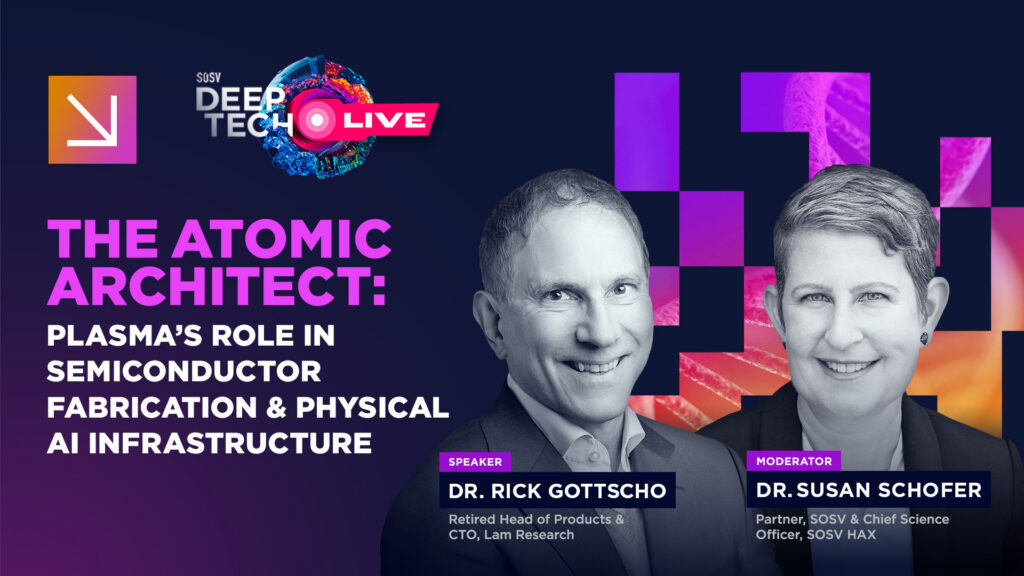
At our latest SOSV Deep Tech Live, Dr. Susan Schofer, Partner & Chief Science Officer at SOSV HAX, sat down with semiconductor legend Dr. Rick Gottscho, Retired Head of Products and CTO of Lam Research, to unpack the past, present, and highly disruptive future of chip manufacturing.
When Rick joined the industry in 1980, engineers were already panicking that Moore’s Law was dead because optical lithography couldn’t scale below one micron. Fast forward to today: we are etching features at sub-nanometer precision. Rick’s takeaway?
“Moore’s law—it’s not dying, it’s just changing. It’s a lot more interesting and challenging now.”
The reality is that without plasma, Moore’s Law would have stalled decades sooner. It remains the foundational technology behind semiconductor fabrication, enabling the etching, deposition, and cleaning of transistors at the atomic scale. Now, as silicon hits its physical limits and AI pushes compute demand to historic highs, plasma is not fading out – it is becoming more critical than ever.
The Turnaround: Brainwashing by Core Values
Before Lam Research became a near-$400 billion market cap powerhouse, it was one quarter away from bankruptcy in 1998. Rick walked us through the dramatic corporate pivot led by incoming CEO Jim Bagley and COO Steve Newberry.
Their secret weapon wasn’t a piece of hardware; it was an unyielding commitment to corporate culture. Newberry spent five years systematically drilling a set of core values into every single employee. Chief among them was “Think Customer, Company, Individual,” alongside a radical expectation of Open Communication. Employees were actively trained to tell management the unvarnished truth and escalate disagreements all the way to the chairman of the board if they felt a decision was wrong. This absolute alignment turned the company around.
Skating to the Inflections: The New Playbook
As CTO, Rick’s mission was explicitly clear: create new business opportunities measured in billions, not millions. To do that, Lam had to stop fighting entrenched competitors for existing market share and instead “skate where the puck is going” by targeting major technological inflections before they arrived.
- 3D NAND: When planar (2D) memory hit its scaling limits, Lam anticipated the shift to the third dimension. By pairing their industry-leading etching with deposition capabilities gained from merging with Novellus Systems, Lam captured 100% market share in critical 3D NAND etch steps, triggering massive corporate growth.
- Dry Resist Lithography: Moving from immersion lithography to Extreme Ultraviolet (EUV), Rick spearheaded a highly speculative, small-team initiative to pioneer dry-deposited metal-organic resists. Though it took longer than initially projected to hit the market, it is now actively taking off as the future of resist systems.
Physical AI Needs a Hybrid Model
In 2015, an off-site meeting with Nvidia’s Jensen Huang fundamentally shifted Rick’s view on artificial intelligence. Huang described how Tesla sensorized cars to gather massive data streams for self-driving.
Rick initially woke up with a headache the next morning, realizing that a pure big-data approach would fail in semiconductor fab. Why? Because a single data point in plasma etching requires cutting a wafer, mounting it, and running an electron microscope – a process that takes a day and costs thousands of dollars.
The solution was Physical AI via a hybrid approach. By acquiring software company Coventor, Lam built fundamental physics, momentum, and energy conservation directly into their machine learning algorithms (leveraging tools like Bayesian optimization). This allowed engineers to drastically accelerate how innovation moves from the lab to scaled production, developing recipes using only a tiny fraction of the physical data.
America’s True Bottleneck: The Manufacturing Problem
Addressing global supply chains, reshoring, and geopolitics, Rick offered a counter-perspective to Chris Miller’s famous book Chip War. While Miller frames advanced semiconductor chips as “the new oil,” Rick argues that losing immediate access to the absolute most advanced node is not a fatal blow. As China’s DeepSeek recently proved, massive software and system-level innovations can elegantly circumvent hardware constraints.
Instead, Rick asserts that the US does not have an innovation problem – it has a manufacturing problem. For decades, offshoring consumer electronics was treated as a margin-saving financial play, ignoring the fact that the factory floor is a problem-rich environment that directly drives long-term competitiveness. To regain true leadership and build a resilient ecosystem, the US and its allies must control the entire system-level ecosystem – from rare earth minerals to advanced assembly.
The HAX Plasma Forge
This critical intersection of hands-on engineering, plasma physics, and system-level manufacturing is precisely why SOSV recently launched the HAX Plasma Forge in partnership with the Princeton Plasma Physics Lab (PPPL).
While PPPL brings world-class expertise in plasma modeling and diagnostics inherited from fusion energy research, the Plasma Forge acts as a collaborative sandbox. It provides startups with the literal laboratories, equipment, and dedicated engineering staff required to bridge the gap between PowerPoint theories and physical, working hardware.
If you are a founder building in semiconductors, advanced hardware, or physical AI, this is the kind of collaboration that changes how you think about the stack beneath the stack. Apply to the HAX Plasma Forge today.
🎥 Find the video below as well as on Spotify, Apple Podcasts, YouTube, LinkedIn, or wherever else you get your podcasts.
📍 Broadcast live from our SOSV NY event space in Manhattan, this is the next installment of SOSV Deep Tech LIVE, our video podcast series exploring the frontiers of deep tech with leading founders, researchers, and technologists. Check out some of our other popular videos:
- Navigating the Realities of Energy Scale Up with Barbara Burger, the “Godmother of Energy Investing”
- Heat Beneath Our Feet: Unlocking Superhot Geothermal with Carlos Araque, CEO & Founder of Quaise Energy
- The 100-Year Quest for Fusion Energy with Sir Steven Cowley, Director of PPPL