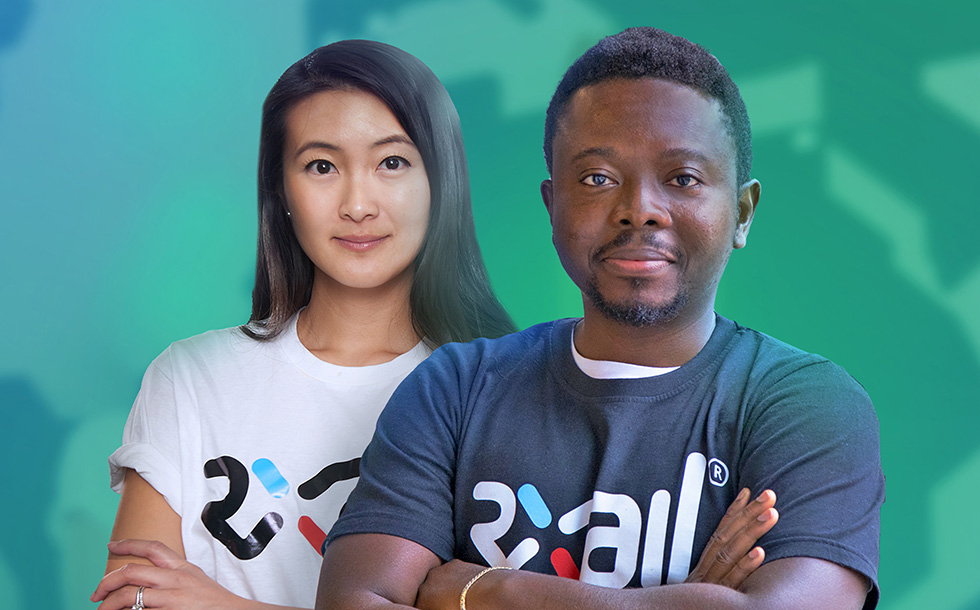
During this year’s Tough Tech Week by The Engine, SOSV hosted a panel on one of the hardest decisions a deep tech founder makes: choosing a co-founder. It ran in the run-up to the Co-founder Search event (Nov 9-13, 350+ registrations).
So how do you find the right deep tech co-founder?
One of the main reasons early stage startups fail is the team. Three leaders whose organizations have collectively backed or supported over 1,000 deep tech founding teams share what they have seen work and fail: who to choose, how to test the fit, and what to avoid.
Hear what Alice Bentinck (Co-founder & CEO, Entrepreneurs First, the first “talent investor”), Riam Kanso (Founder & CEO, Conception X, the home of the “venture scientist”) and Susan Schofer (Partner & Chief Science Officer, SOSV HAX, “first check in deep tech™”) have to say. Benjamin Joffe, Senior Partner at SOSV, moderates.
Here are six takeaways from the discussion. Attendees who rated the panel gave it 4.7/5.
1. The wrong co-founder is worse than no co-founder: This might be the most crucial hire you’ll ever make. Don’t settle for someone just because they’re a friend, colleague, or conveniently available.
2. Scientist + MBA ≠ Dream Team: Forget the simplistic technical/commercial pairing. Technical founders can make excellent CEOs. What matters is shared ambition, complementary strengths, and a willingness to learn. You don’t want your clone. But you probably don’t want your polar opposite either.
3. Don’t just talk. WORK together: Alice shared a practical approach: successive 40-hour working sprints with potential co-founders. Were you productive? Did you enjoy working together? Did you challenge each other constructively? If not, move on. Better to discover incompatibility in 40 hours than after 4 years.
4. Chemistry is great. Commitment is non-negotiable: Someone can be brilliant, enthusiastic, and a perfect match on paper. But if they’re not ready to go all in, they’re not your co-founder.
5. Missionary or mercenary? You need some of both: Deep tech founders often start with a scientific mission. But building a company requires adapting to market opportunities, funding realities, and customer needs. When co-founders fundamentally disagree on where to draw that line, trouble follows.
6. AI changes the equation. But not necessarily how you’d expect: AI enables small teams to accomplish what once required dozens of people. But it also makes it easier to generate impressive-looking demos without genuine validation. As execution gets cheaper, judgment, critical thinking, and the ability to challenge each other’s assumptions become even more valuable.
Check out the full video recording and transcript below.
Full conversation on Youtube | LinkedIn recap
Transcript lightly cleaned for readability:
Benjamin: Welcome, everyone. We’re going to take the first few minutes to let people arrive and join us. It’s going to be a very interesting discussion, in the middle of Tough Tech Week and more broadly for anybody interested in deep tech. The topic of co-founders, particularly at early stage, is one of the most difficult ones to address, and one of the major causes of startup troubles, way before they run out of money or get killed by a competitor or big tech.
We’ll start with a short introduction of our speakers. We have three fantastic speakers, the most relevant for this topic because they work at the very earliest stages with deep tech startups, and they have worked with many hundreds of startups so far. They’ve seen a lot, developed some interesting pattern recognition, and can share some hard-learned lessons.
Without further ado, I’ll ask Alice to introduce herself. You’re the co-founder and CEO of Entrepreneurs First. I was a participant a few years ago. I took a short career break to explore startup ideas, and I found your model very interesting and intriguing, and also very efficient from the inside, if a little unsettling as you explore, in a very short time, how you can find a co-founder. Alice, tell us more about Entrepreneurs First and your model.
Alice: Hi everyone, great to meet you all, and thank you for joining. At EF, we invest in people before they become companies. We bring together very talented people, often with deeply technical backgrounds. We’ve worked with a number of PhDs and postdocs over the last 10 years, and we put them together in cohorts where they can develop ideas from scratch and meet their co-founders. We started the model in Europe and still do a lot of work there, but we now incorporate all of our companies in the US and bring them here to fundraise and to access the US market. We’ve built companies that are now worth more than $25 billion, and we’re backed by some of the biggest names in venture and founding, including Founders Fund, Greylock, the Collison brothers, Eric Schmidt, and many others.
Benjamin: Fantastic. We may touch on the differences between ecosystems and their suitability for deep tech startups, because that’s probably one of the reasons you’re in San Francisco now as well. Moving on to Riam Kanso, founder and CEO of Conception X, working with scientists to turn them into entrepreneurs and venture scientists. Tell us more about this model.
Riam: Absolutely. I’m very glad to be here. At Conception X, over the last eight years, we have been identifying and backing venture scientists. These are researchers who combine deep scientific expertise and commercial judgment, and who lead on commercializing their breakthroughs with a sense of agency. Our model identifies them and works with them to build these companies. Over the last eight years, we’ve built around 250 companies from over 91 universities, spanning deep tech. For companies pursuing scientific breakthroughs at the very early stage, we found that the scientific and commercial decisions can be deeply connected. That’s why we try to find these founders and back them.
Benjamin: It seems very challenging to find a scientist who also has this kind of commercial sense, but you’ll tell us more about that. Now, my colleague Susan at SOSV HAX. Susan, can you tell us what you do and what HAX does within SOSV?
Susan: Thank you, and thanks, everyone, for being here. I’m Susan Schofer, a partner at SOSV and Chief Science Officer for HAX. At SOSV, we invest in early-stage deep tech companies. That’s often a similar stage to everyone else on this call: researchers with breakthrough innovations who are taking their first steps out of a lab to commercialize through a startup. We do not find founders or match them per se, but we do a lot of university engagement, because we’re always looking for very early-stage ideas and helping to nurture them through. SOSV actually has a trademark on the phrase “the first check in deep tech,” which gives you an idea of where we like to invest. At HAX, we focus specifically on hard tech within deep tech and work very hands-on with the founders we back. My own background is a PhD in chemistry, and then I spent my career in venture-backed startups, so I’ve been through the journey from researcher in academia to thinking about commercialization and learning how to take innovation from lab to market.
Benjamin: To give a sense of scale, how many deep tech startups does SOSV back every year?
Susan: We start with our companies at the earliest stage, and we back about 60 to 70 new companies per year. We also follow on into those companies. In total, we’ve backed about 800 startups, and probably hundreds of them are still ongoing. We’re currently investing out of our fifth fund, a $306 million fund.
Benjamin: Excellent. Let’s get started with some simple questions. Since we’re talking about how to find the right co-founder, the first question: do scientists or founders of deep tech startups need co-founders? Let’s start with Riam.
Riam: It’s a great question. A great co-founder is an excellent choice, but a bad co-founder is worse than no co-founder. What we’ve found over the last eight years of backing companies is that, interestingly, the best co-founder pairings are people who have worked in the same lab together and tried to crack problems together. That shared expertise, working together on a breakthrough and then going out to commercialize it, has made some really good pairings. It’s one of those wide-ranging questions where you can’t give a blanket black-and-white answer. But the world has moved on from a very sharp definition of technical and commercial, because models have evolved. If you’re building a breakthrough, you also need some commercial idea of where you want to take it. Co-founding pairs that are built in haste are very high risk and tend to fall apart. It will be interesting to see how things evolve with new deep tech models as well.
Benjamin: I’d like to move to Alice now, because your model is quite different. If I recall correctly, at the time you were discouraging technical talent, particularly scientists, from getting together. Like you said, it’s better to have different skill sets. I understand that what people don’t have in trust from years together in the lab, they might have other advantages. Can you tell us more about your thinking? And since Riam mentioned that finding a co-founder in haste leads to high risk, what’s your view on that? Your program pairs people in a pretty short time frame.
Alice: There’s a lot to unpack there. I strongly agree with Riam that no co-founder is better than the wrong co-founder, but there’s much you can do to find and test the right one. One thing I would push on: you are not looking for somebody who is your polar opposite. If you are a PhD or postdoc, do not co-found with an MBA. You will not have enough shared language, ways of working, or context to work together effectively.
The way I think about it, there are two roles you need in a co-founding team: a CEO role and a CTO role. Technical people can do both, but you have to want to do that role. If you want to be the CEO, you need to want to do fundraising and think about the commercial vision and strategy of the business. There are lots of technical people out there who do want that, and there are many examples, whether Bill Gates or Mark Zuckerberg, that prove technical CEOs can be wildly, wildly successful. But you need to want to do it. You’ll always be surprised how much of a CEO’s time is spent fundraising.
How do you find a co-founder if you haven’t met your dream partner in your lab? I agree that finding someone you already have a ton of experience with is a fantastic outcome. And I agree with Riam: don’t be hasty, but it’s not impossible. A large part of the EF process, where we’ve built hundreds of co-founding teams from scratch at this point, is being really intentional. It’s so easy to find the co-founder of convenience: you look around and say, “Hey, you and I both want to start a company, let’s try to make it work.” That is probably a bad idea. Be intentional. First, understand what you want to build and which ideas you’re interested in.
Then test. Set up explicit tests with people that are 40 hours long. Run a sort of hackathon process with them, and at the end ask yourself: did you feel super productive working alongside this person? If the answer is no, it’s probably not worth continuing. If the answer is yes, do another 40-hour test. At the end of each of these sprints, have a very, very direct conversation with each other: did that work? Do we want to keep working together? Stick or twist.
I was recently working with a deep tech founder outside of EF who ran her own process. Every week she was in the EF office in San Francisco with a different co-founder, and she went through probably six or seven. She’s now out raising a Series A, 12 months after she raised her seed. She was so intentional about testing the productivity of each person she worked with, and so strict about whether it was a fit, that if she had any concerns, she didn’t make it happen.
It’s also worth saying that there are a bunch of ways to make a founding team work beyond a single co-founder. We have a very large space company called Open Cosmos that just raised $300 million. They’re building Europe’s Starlink, basically. A deeply technical individual came to us with a very clear idea: making low-cost satellite constellations. He ended up building a founding team of four people around him, bringing aerospace engineering, manufacturing, and machine learning expertise. It was a co-founding team rather than a co-founding pair. The difference is that you are not splitting the equity equally among all those people. It’s very hard to run a company by committee. You need clear leadership. But a co-founding team rather than a pair can be an option.
Benjamin: Thanks a lot. There’s a lot to unpack here. Susan, what’s your take on the best pairings you’ve seen through the startups you’ve worked with at HAX? Have you also seen successful teams of solo founders with, say, a first engineer and that type of matching?
Susan: I’ll say a few things. Number one, at SOSV we believe technical folks can be founders and can certainly be CEOs. As was already said, it’s a question of aptitude. Coming from academia, from being a researcher, science is important and technology is important. But at the end of the day, it’s a big mindset shift to go from a lab where you’re just asking research questions to taking in external information, getting to know customers, and understanding what the market wants. That’s a huge shift. So one question is: do you want to make that shift? Are you open to it? For me, that’s a fundamental question. If you’re starting a company, even if you end up in a CTO role, you need to be open to that.
Having a co-founder is important for a few reasons. Being a founder is challenging. It’s a huge commitment, and you’re on an emotional roller coaster. Having someone there for you day and night as you go through all these challenges is really valuable. But I agree, it’s not about your polar opposite. It’s maybe not about someone exactly like you either. It’s about the right match, so you need to be careful. The main reason early-stage startups don’t succeed is probably the team, so you need to be really thoughtful about who you choose.
The worst of it is when academic or innovation and entrepreneurship groups at universities try to pair MBAs with scientists. Yes, they have complementary skills in theory, but you need to be more intentionally complementary than that. We’ve seen very successful teams that met through the EF process, so that does work, and at the same time sometimes it doesn’t. It’s all about being intentional: knowing who your founder is, who’s going to do which role, defining that and being comfortable with it, including being comfortable with a team member who does something you don’t do. One of the biggest concepts you don’t learn in academia is that teamwork is not about being exactly even and fair and perfectly the same. It’s about being complementary, and the strength of two people is greater than 1 plus 1.
Benjamin: Any parent out there will probably recognize some of that pattern. Being more than one to manage the project covers some of your blind spots. Everyone has some kind of blind spot, or even a dip in energy at some point in the journey of a startup, which is very demanding.
We’ve already covered some of the topics: how to find the right complementarity or alignment, the CEO role and the CTO role, and the fact that those roles have to be defined and taken care of even if it’s not somebody’s training. Any scientist could manage the business part if they want to. Is that something you’re confident about? Starting with Riam.
Riam: Absolutely not. Neither should they. We’re a small subset, just like there’s a subset of people who make fantastic founders and a subset who make fantastic venture scientists. There’s an aspect of communicating your story and convincing investors that you are so obsessed with the problem you’re trying to solve that, even though not everything is figured out right now, they will invest in you, your persona, and your background to figure things out. At the very early stages of building a deep tech company, so much is unknown. You can go to investors with a fantastic pedigree from a top lab at Oxford or Cambridge or anywhere, with a great idea. But there’s also something the best venture scientists are able to communicate: “I am going to crack this, and I’m going to convince you to give me time, money, and expertise to make this work.” It’s a very specific characteristic that we look for. It’s not necessarily someone who pitches well or is media trained. There is just this characteristic that comes across.
With co-founder pairs, they really need to be aligned on what problem they’re actually solving. It’s a small thing, but if your idea changes every two minutes, and you say, “Right, we’re going to make money like this, and like this,” that’s a problem. If they’re aligned on what they’re cracking over the next three years, and they understand that maybe one of them will communicate this more to investors while they work together on building it, that’s a magical combination. Every year, as we bring founders into our Venture Scientist 100 Fellowship, you start seeing these things emerge.
The tricky part is that sometimes they don’t know from the beginning that they’ll want to talk to investors and really love it. Some come in thinking they’re the best person to pitch the company, and it turns out they’re not. Others say, “Actually, I’m terrible at this, I don’t like selling, I’m a scientist,” and end up being the most convincing CEO of the company. So they need time to experiment in a safe environment to see what they can do.
Benjamin: Moving on to Alice. Do you see the founders you work with transform? Or is it “you’re good at this, so you do this”? To quote Riam, sometimes you think you’re good at something and you’re actually not, and somebody who doesn’t think they’re good at it may be better. Do you see founders evolve?
Alice: If you step back and think about Bill Gates or Jensen Huang, who they are today is not who they were 10 years ago. As a founder, you are going to be on the craziest growth journey you’ve ever been on. You are going to be allowed to do things, and you’re going to need to do things, that no one would pay you to do, because you don’t have the skills, experience, or expertise. The best founders are what one of our investors, Reid Hoffman, calls infinite learners. You have to want to be on the edge of what you feel comfortable doing at all times.
Some of you might be thinking, “Well, of course I’ve always been an infinite learner.” But you might have a growth mindset about the technical things you work on and a very fixed mindset about learning the more commercial sides of running the business. I’ve worked with founders who were very creative and truth-seeking on the technical side of the business and then really avoided learning the skills and the behaviors they need to run the commercial side.
When you go through fundraising, there are certain things you need to do, certain ways you need to behave, to show that you are one of the highest-performing companies of your generation. The best founders are pretty fungible, happy to wear different hats at different times to do what it takes to succeed. One of our investors always says he wants the founder who’s willing to put on a pink tutu and sing in the middle of the Golden Gate Bridge, even though that makes them super uncomfortable, if that is what it takes to succeed.
Being deeply technical or not, I don’t mind. What we look for are founder traits: megalomania, an interest in and desire for power; obsessiveness, being able to go super deep and get obsessed with one particular thing; and pronoia, believing the world is conspiring in your favor to help you succeed. We select people rather than companies when we first invest, and we’re much more interested in your beliefs about the world and how you behave than in your idea, because beliefs and behavior can be nudged. Ultimately you have to have the openness to want to become the most founder version of yourself rather than the most academic version of yourself.
Benjamin: Does that resonate with you, Susan, with the founders you’ve worked with? This obsessiveness and desire to learn way beyond their comfort zone, which is generally technical?
Susan: It’s exactly that. If you want to be a founder, even if you are technical and a CTO, you have to be really willing to learn. The best founders are scrappy. They’re willing to pivot. They don’t know everything. They’re out there learning all the time and translating those learnings. We also say great founders are on the border of being unhinged. Not completely crazy, but on that borderline. You have to have something in you that drives you to put on a tutu on the Golden Gate Bridge even though it’s uncomfortable. That’s the personality you need to be a founder: willing to learn, willing to be wrong, willing to be open and admit when they don’t know things.
I think that’s part of the magic of a co-founder. Having someone else in the room with you when you’re going through this is so valuable. You don’t really want to do that alone. It’s not to say it can’t happen. There are definitely successful companies we’ve invested in with solo founders, and it does work. But if you can have a partner, I think you’re in the best place.
Benjamin: In this idea of the business and technical sides, what are the typical things they tend to misunderstand about each other? Susan?
Susan: I can think of a great example: a company we invested in over the past couple of years in the robotics space. The co-founder CEO was trying to figure out what the market really needed for them to succeed, and also what investors want to see. At the same time, the CTO was trying to keep up and meet that. There’s an important point here about managing expectations. There’s an art to understanding what the market and investors want, but also tempering that against what’s feasible in the near term so you can hit milestones. In the end, this company didn’t succeed as a team, because that was so out of alignment. On the business side, there was a desire to take literally what people were saying, “You need to do A, B, C,” rather than temper that and translate it into: “We can do these things, and in the meantime we can do these other things to prove that this is de-risked, that that is de-risked, and that we’ve shown demand.” Putting those pieces together is the role of the CEO there.
There’s a role to manage expectations to protect the technology. Sure, if you fully build it, they will come. But as we all know, in early-stage startups you can’t fully build it from day one. There’s an art to figuring out the intermediate step and how to communicate it to the various stakeholders, and to protect and align with your tech team. How do we find the right middle ground and walk our way there while we’re learning to run?
Benjamin: There’s some tension between, at one end of the spectrum, pure business thinking, which is “let’s do whatever we’ll sell,” and, at the other end, an artist or a researcher: “This is what I want to do, and I don’t want to deviate from that.” Every founder is somewhere on that spectrum with some flexibility. If it clashes with co-founders and with the market, you can end up in a difficult situation. Riam, you seem to be agreeing. If you stretch a scientist too far away from what they actually want to do, or from the markets they want to address, do they come back like a rubber band?
Riam: Yes. On the rubber band, and going back to your earlier point about commercial versus scientific: what it means to have the commercial skills changes a lot based on the stage of the company. When you’re just starting out, you’ve built a breakthrough technology and you don’t necessarily know what market it’s going to be in. Take Rahko, one of our first companies to exit. They built a quantum drug discovery company and were acquired by an American pharmaceutical company. When they started out, they thought they were building a battery company. Because it’s an algorithm, who knows what market it will land in? What they needed up front was someone with the right experience to explore these things, understand the market, and nudge them toward the market they wanted to build in. Do you need a co-founder for that? Maybe, but usually you need an advisor or a mentor, and there are lots of excellent ones around.
As you grow the company, what it means to have commercial expertise changes quite a lot, because then you’re going to the pharma companies and so on. It becomes so nuanced that each company is like an ecosystem in itself, so I don’t think we can draw a line between commercial and technical. If you paired scientists with MBAs, and I’m really glad that on this panel it’s not even a topic of discussion, that would be a non-starter. What would they do with it?
On the question of stretching the scientist: they’ve solved the problem and they want to see it manifest in the world. If someone has built a fantastic algorithm that could be used for anything, in principle you could use it to make a super addictive social media company and make a ton of money. But you can use the same principles to build new drugs or facilitate a supply chain. So it’s also a moral question. Sure, it’s still solving a problem, but where do they want to see it applied? This is where the team matters a lot, and who advises them at the beginning, and how they grow it.
Benjamin: I’ll ask Alice for her opinion on that, because we’re at the midway point of this session and I’d like to start talking about where we find those co-founders. But before that, Alice, do you have any comment on the current question?
Alice: One thing to add: people often categorize founders as missionaries or mercenaries. Missionary founders are really fixated on solving a certain problem. There’s a mission they care about and want to solve. Mercenary founders are just trying to make money and chase whatever’s hot. The old adage is that it’s better to back missionary founders, but I’d push that you need to be at the intersection of the two. Often where I see academic founders go wrong is that they are too missionary. They’re too attached to a particular technology that they’re trying to find a use case for.
One of the best founders I’ve seen do this is the founder of PolyAI, Nikola, who had just finished his PhD in machine learning at Cambridge. When they first started building the company, chatbots were very hot. This was 2016, a while ago. They were one of the first companies to build a really humanistic chatbot experience. What they ended up doing was hyper-realistic voices for customer service. What I love about them is that the more time they spent with customers, the more they built what customers needed. I don’t know if you’ve been to Vegas recently, but if you’ve contacted anyone there, whether a restaurant or a hotel, they basically run all of the customer service backend. The founder, instead of saying, “This is the technology I care about and I want to bring it to the world,” spent more and more time with customers building the products they needed. Some of it was based on what he had done in his PhD, but much more importantly, he was looking for the massive opportunity. They recently raised, I think, $150 million, and it’s because he was obsessively looking for the opportunity, the mercenary side of things, rather than just the technology he wanted to bring to the world.
Benjamin: So the technology was the first wedge into getting to know an industry, and from there he explored what bigger needs he might answer.
Alice: Yes. And technology these days is becoming commoditized so unbelievably quickly that it is not enough to be at the forefront of your field. The time when you could have a nice green field where no one else is competing with the same technology is basically non-existent now.
Susan: To double down on the missionary-mercenary intersection: the other watch-out I’ve seen from my startup experience is that it’s important to be mission driven, but you also need to find a route to market. We had a lot of conflicts in a biotech company I was part of because we were mission driven. We had some opportunities that were a little off the mission, less climate and more oil and gas, let’s say, as intermediate beachheads. The question becomes: do we take these opportunities to get some revenue, to prove some product-market fit, to prove that we can take this technology to market on our way to the bigger mission impact? It plays out in various ways. If you’re only thinking about the mission and not willing to take other opportunities along the way, you might not have a company to achieve that bigger mission. So it’s important to keep a little of both in mind as you go forward.
Riam: You’re not going to have a venture-scalable company if you’re not a little bit mercenary. It just doesn’t get there. But from the angle we’re looking at, we still have a lot of interesting new breakthroughs coming to be commercialized, so we’re going to see a lot of those.
Benjamin: Now I’d like to shift gears to how people can find those co-founders. The classic route is colleagues, friends, friends of friends. There are not many places to look, and this is probably the most important recruitment that happens in a company. I’d like to hear your approach. We can start with Alice, because you have a very particular model, where you bring people together. I’d also be curious about who you select and how you reach out to them.
Alice: You framed it perfectly. This is the most important recruitment you will ever do in your life, and the most expensive thing you will ever do is get a co-founder. My co-founder actually started EF a month before I did, but he still gave me 50% of the company. That was the most expensive decision he ever made. He needed to believe that I would at least double the outcome of EF to make that worthwhile for him. At EF, we have a very specific process where we bring together 50 people at the same time who are ready to found. We think about the composition of those individuals, both their technologies and interests and their personalities, to make that process as efficient as possible.
If you’re looking to recreate that process outside of a program like Entrepreneurs First, my advice is this: it is a recruitment process, and you need to run a process. That means you need a top of the funnel. Without a top of the funnel, you will stick with somebody who is not necessarily the right fit. Comparing different co-founders is very helpful. So how do you generate a top of the funnel? You’ve got to do the work. It’s hard work, which is why people come to EF. It means finding second-degree connections, finding people on Twitter, going to meetups, putting yourself out there. Stage one is generating a funnel so you can have those conversations. You will meet a ton of people who aren’t the right fit, but in every single conversation, ask: Who else do you know that I should meet? Who else could help me think this through? Who else is available now? Try to use every meeting to get two more meetings, so you can exponentially increase the number of people you’re connected to.
Benjamin: One thing you said is interesting. I remember from my EF experience that it was very unique to be with a group of people who were competent, because you filter for competence when you recruit participants. They were motivated, and available, because they took time out of their normal lives to do this. And here you said, “Who else is available?” The problem is that a lot of people are not available, particularly if they’re competent. They’re employed somewhere. Even when you recruit participants, people are probably doing something else while you’re reaching out to them. How do you get over that hurdle of availability?
Alice: It is one of the biggest failure modes, and one of the most frustrating. Somebody gets really excited, you’re really excited, they’re really excited about you, and then comes the “you said you were going to quit your job” conversation. Suddenly their partner doesn’t want them to quit their job, quitting doesn’t seem so appealing, and you’ve just wasted all that time. So this is a conversation you need to have upfront, to assess how ready and prepared they are to quit. It is a fine balance, though. They need something to quit for. They need to get excited about you and what you could work on together. So you’re building the relationship and getting them excited about what you could co-create, while at the same time taking them on the journey and being very clear that if they want to do this, they need to work on it full time.
I know there are many stories of people who built startups part time, but being a founder is one of the hardest career paths, one of the hardest things to succeed at. There are more Olympic gold medal winners than there are founders who have built billion-dollar companies. If you want to play in the big leagues, this needs to be something you fully, fully commit to, and making sure that you and your co-founder are clear and aligned on that upfront is super important.
Benjamin: Excellent point. Riam, you work with scientists, but not necessarily teams when they start. Do you play a role in the matching? How do you think about those dynamics?
Riam: We don’t have a formal, time-bound co-founder matching process. It can happen at any time. Conception X runs over nine months, the Venture Scientist 100 Fellowship, and then afterwards. We currently have the largest European community of venture scientists, and lots of people who have gone through the program and not ended up building companies. Some of them make amazing co-founders. As our alumni network has grown, we have a lot of events where these people meet each other. We now have second- and third-time founders looking for others to build with. So that’s how we do it, but it’s a more organic process.
The other thing is that in our model, in the first year or two of building a company, people are building it within their research groups at their universities. A lot of these companies require very expensive equipment, like gene sequencing machines, spectrometers, and high-performance computing, so building within the university is super useful. They also have their own community there where they can pair with others.
Benjamin: I’ll turn to Susan. In the case of SOSV and HAX, in most cases the team comes fully formed, but there are exceptions. SOSV is also now working at an even earlier stage and may participate in team formation. How do you advise founders on the profiles they need, and on how to go about finding that co-founder?
Susan: We don’t claim to be able to find people co-founders because, as Alice and you are saying, this is a real profession. I can’t just materialize the right co-founder when you need one. It takes a lot to find one. We don’t have a deep bench of EIRs or anything like that, and it takes very bespoke, very specific effort. Obviously, you should attend the SOSV co-founder matching event. That’s how you can find a co-founder.
The advice I typically give is this: we definitely make investments into solo founders. It’s not our preference, but we do it. Then, depending on the situation, they’ll find a co-founder. The question is: what are the gaps you have? Either you want someone who really knows the industry you’re going into, so they can give you a leg up as you start doing sales and engaging customers. That depends on the industry. Some industries are much harder to crack than others, and if you bring in someone with no experience, you’re not going to get the conversations you need. If you’re selling into legacy industries, probably healthcare or oil and gas, you really do need someone who has credibility there.
The other side of that coin is someone who has commercialized innovation. Maybe they don’t know your exact industry, but they have taken something from lab to market, or seen that through, and done something very brand new. That in itself is a skill set. If you’re a solo founder coming out of academia, someone who has gone through that execution can be a really good pairing.
It’s a process, and you can’t really have a playbook for it unless you’re in the shoes of EF, where that’s literally what you do professionally, spending a lot of time finding these co-founders and setting them up to be matched. Otherwise, you have to take the process and spend the proper amount of time on it.
Benjamin: I’d like to move to another aspect of this matching. If you have additional avenues founders could look into to identify co-founders, please chime in. But then there’s the question of how you evaluate the fit. Alice, you mentioned earlier that the metric is: are you getting more productive together? Are you a lot more productive than when you were alone? That seems to be the key metric. Do you want to comment on that, and on how it became your metric at EF?
Alice: It’s worth clarifying what productivity means for two strangers in the really early process of getting to know each other. The first step in productivity is: can you agree on a starting point for an idea? It’s so common to see two people who really like each other. They’ve become friends, or maybe they were already friends. When I speak to them, they say, “Yeah, we’ve got so many ideas, we’ve been super productive, we’ve come up with loads of ideas.” And then one of them says, “We could do this thing,” and the other one says, “Oh.” They get stuck in this doom loop where they’re both really excited about ideas, just not about the same idea. Because they’ve become such good friends, they ignore the glaring fact in front of them: they’re not aligned on their interests.
So that’s productivity piece number one. Can you actually agree on a starting point? The word “idea” is often pretty unhelpful. Google is an idea, Anthropic is an idea, and so is what you thought about in the shower this morning. You’re just looking for a starting point. Can you agree on a place to start?
Productivity then is not just about action. Inputs feel very satisfying: we’ve set up 20 calls across 20 hours and we’re going to speak to as many people as possible. At this early stage, productivity is learning. Are you coming up with hypotheses that you validate or invalidate? If you invalidate all of them, great, that’s super productive. Do you then have the creative muscle to generate the next set of hypotheses based on what you’ve learned? What you want to see is your learning compounding over time, so you make better and better, more insightful hypotheses.
So yes, there’s a bunch of input. You want to go speak to customers and to each other. But the output, the productive thing at this stage, is that when we look back on what we’ve learned over the last 48 hours, we can point at where we started and where we’ve got to and be really pleased with that progress. Are we becoming more excited about the same things, or are we diverging and becoming more excited about different things? That is also totally okay. With all of these things, it’s about having the conversation: “This is what I’m observing over the last 48 hours.” This is why we say 48 hours for testing. Anything longer and you begin to form attachments to different ideas and to each other. You want things to be fast, in the moment, low friction, low confrontation.
Benjamin: Interesting. Riam, do you have similar experience with your companies and founders?
Riam: We’ve had things come up over the last years to assess this. One of the things we look at: say you have two people building a company based on a patent or a discovery, and maybe one of them has worked longer on the research and the other can contribute, and they want to be co-founders. It’s very common for this to come up: “Well, I’ve spent the last two or three years writing papers about this, so I think I should own 70% of the company, not 30%.” It’s a very good indicator if you can sit them down together and say, “You have to forget a little of what’s been done to date. You have to look at the next 10 years. Are you both going to be solving this? Maybe the final product is going to look very different from what you’ve published in the paper.” People who can overcome that and leave a little of this legacy publication ego behind tend to do better. Even if they agree to form the company at 70-30, it just ends up building resentment, and someone wants to put in 30% of the effort. These things don’t work.
For us, over a slightly longer time span than 48 hours, which is just how Conception X runs, what we test for is: have you managed to disagree over something and still hit a milestone? That’s really important, because people are still going to disagree. But if they ship something, build the prototype, talk to a customer, or get a letter of intent, that’s a good sign. We don’t want people who are just super agreeable and friendly with each other.
Benjamin: So you can talk it out and find a solution, whatever that solution comes to be. Susan, any input on this particular topic, the evaluation of the match?
Susan: A lot of good things have been said. I don’t know if what you’re saying, Riam, is that all founders need to be 50-50. That’s certainly not always what we see. In some cases we have solo founders who find a co-founder a little later, and they would not own as much of the company, which makes sense because they came in later. Certainly this idea that you need to be able to disagree, work through it, and get past it is a healthy dynamic for any company. If you don’t have the ability to have different opinions, talk it through, come to a conclusion, and get past that, it would never work. And you really don’t want anyone in the company who is submissive in their opinion just to get along. That would not be the best for the company.
The execution that happens after you leave the lab is where all the value is created. Of course the technology and the IP matter, but so much value is created after that point. It’s important to remember when you’re founding a company that the challenges are ahead of you, not behind you, so I hope that helps frame people’s thinking on ownership. One thing we see is that some co-founders remain in academia, like professors. They can certainly own a part of the company, but typically a smaller amount, because they’re not taking on the risk the operating founders are, and they’re not leaving their full-time jobs. Something to keep in mind.
Benjamin: And as Riam mentioned, sometimes the company can evolve beyond what the initial publication or research was about. That’s another argument against the aggressive licensing terms some universities have, which really create trouble for startups.
To wrap up this aspect of the fit between co-founders, it’s the mirror of the previous question: have you noticed particular red flags that jump out at you? It could be after spending time with a co-founding team, sometimes post-investment in SOSV’s case, when you think, “This is not going well. We didn’t see it before, we see it now, and this is not viable.” Or before investment, when you have something really promising on the tech front, but red flags are appearing in the founding team. Any thoughts that come to mind, Susan?
Susan: People who have really different ideas of what this is going to be like, or really different ideas of the level of commitment needed to make the company work. We’ve seen that cause teams to fall apart, where one of them is scrappy and willing to do whatever, and another is very committed to a certain angle on the technology, or a certain opportunity, or a certain work-life balance that isn’t realistic for an early-stage founder. That would be a red flag. Another is not being willing to be flexible and do what it takes. Even though you want co-founders with clearly defined roles, CEO and CTO, which I think is important, people need to do what it takes to get it done. If someone thinks “that’s not my role,” that’s not going to fly. It’s a partnership, and you need to be there for your partner and do what it takes for the company. If you’re building a company, you’re building it to make the company successful. It becomes less about the person or the people and more in service of the greater thing you’re building together. That’s the mindset you really need to have. If you don’t, that is definitely a red flag.
Benjamin: In service of the idea or the project. Alice, any thoughts regarding red flags?
Alice: To summarize some of the things I’ve said: low productivity, not being able to make decisions together or decide on an idea. Founders who are obviously very good friends and have come to like each other a lot, but aren’t making any progress on the business. And when one founder isn’t willing to quit what they’re doing and go in full time. Those would be my main flags.
Benjamin: Riam, any thoughts on this one?
Riam: If the stakes are higher for one of them than for the other, it tends to create an imbalance sooner or later. If someone has a backup job, or they’re in it to see if it works, testing the waters and may or may not stay, it creates a huge imbalance. If they’re both all in, or all three of them, that’s when it works better. Also, and this is an early signal, if people are arguing over who’s going to be the CEO of the company, it signals more than “what role am I good for?” It’s about titles.
Benjamin: Maybe it’s a signal of some problem with the matching. We only have a few minutes left. I saw some questions, and I addressed a few during the conversation. Before we finish, I want to address the elephant in the room, the A word: AI. Has it changed anything for you? Some context: I’ve been reading the series of articles Steve Blank published about his Lean Launchpad. He basically threw a wrecking ball into his model of supporting companies on building startups, because startups would come in with something they believed was a minimum viable product, but was really something well developed that was still absolutely untested. Any thoughts on that? Starting with you, Riam: has AI changed anything in this challenge of finding co-founders? Maybe partly because non-technical people are now able to do more with AI.
Riam: How AI is affecting startups is a huge topic. It needs its own panel. But I’ll comment on a specific part of it: what tools like Claude for Science are doing for deep tech companies, specifically new AI products that automate scientific discovery or find proteins faster. The early signals we’re getting are, first of all, that they are absolutely not replacing the scientific founder, because you still need to be able to ask the right question and query what comes out.
Benjamin: They need the domain knowledge to evaluate, right?
Riam: Yes, you need the domain knowledge more than ever to ask the machine what you want and what you can find. But the early signal we’re seeing is that it’s becoming possible to have a two-person, two-PhD material discovery company, or a protein discovery company, because the things being automated were labor-intensive, expensive processes that maybe needed a whole lab or an army to do. If you’re asking the right questions, there are parts of this process that are now more accessible for building a company.
Benjamin: That doesn’t change the composition of the founding team, but it changes what they can do with capital and velocity.
Riam: Definitely. You can do things faster, but you still need to ask the right questions and see what comes out of the simulation.
Benjamin: Alice, do you also have a point of view on what AI has changed in co-founding dynamics, if anything?
Alice: One of the challenges is that it’s never been easier to make progress and get traction. The challenge with that is that it can sometimes feel like you have found something when you haven’t. So finding a co-founder where you set up from day one that you challenge each other and really truth-seek to find the answer has never been more important. Customer development is still super, super important.
Benjamin: Susan, any thoughts on AI and the founding team and team dynamics?
Susan: AI has obviously changed the whole landscape of startups. At the same time, it doesn’t replace judgment. You can crank through a lot more things more quickly. Sure, it means less technical people can be more technical by looking something up on Claude, but what Claude doesn’t replace is perspective, context, and expertise. It can give you a lot of answers, and if you’re a really smart person, you can digest that to make it meaningful, but the most impact will still come from having the context and the landscape. I can ask Claude whether something is a value prop and then go out to my customer to figure it out, but what I really need to validate it is still customer conversations and my knowledge of the industry or the technology. So it can give me a lead.
It helps, and I agree with what you said, Riam: we can eliminate some of the experimental work and speed it up, because we can have more robotics plus AI. But it doesn’t eliminate the need to really understand context, which as a founder is your main job. There are so many little nuanced things: reading the room, understanding people, understanding the exact context. I don’t think you’ll replace it. You can make yourself more efficient, because you can get more information more quickly.
Benjamin: Thanks a lot for this, and thanks to all three of you for your great insights. As Susan mentioned, SOSV is organizing a matching event from November 9 to 13. It’s the first time we do this: we invite people with a project and people without a project in deep tech to meet online. We have over 300 people registered, many of them with PhDs in many different domains. It’s a free event and an experiment, but it should be quite interesting. We have some interesting tooling behind it to facilitate that approach, and we hope to make it easier to find interesting co-founders for your project, or, if you’re looking for a project, to find something you’re interested in. Thank you very much for your attention.