
The AI industry wants to connect entire cities’ worth of electricity demand to the grid, and it wants the power almost immediately.
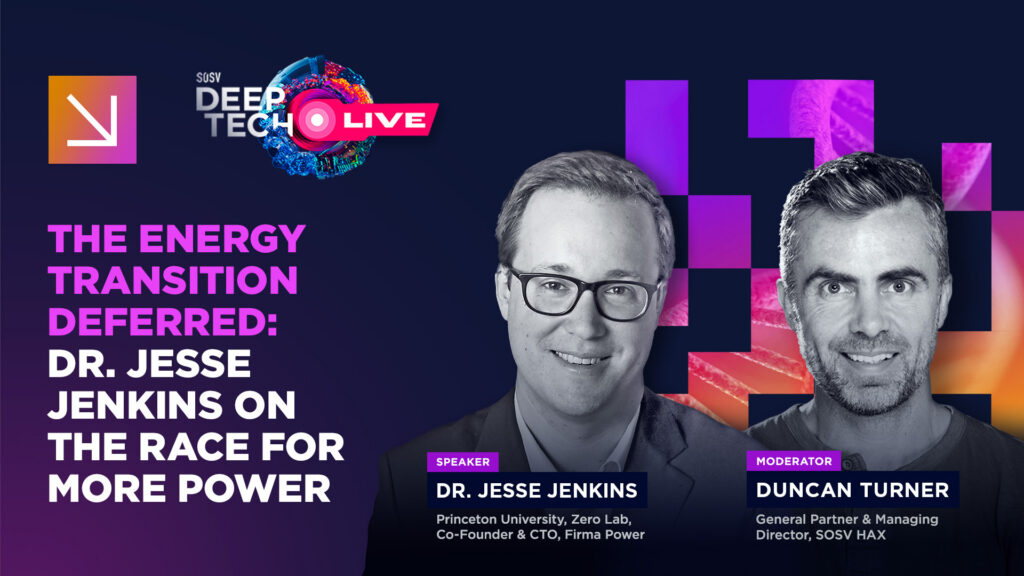
What that means for energy prices, clean technology, and the communities being asked to accommodate the buildout took center stage at SOSV Deep Tech LIVE during Climate Week NYC.
The conversation brought together Princeton’s Dr. Jesse Jenkins and Duncan Turner, General Partner and Managing Director of SOSV HAX. Jenkins leads Princeton University’s ZERO Lab and has also moved from analyzing the energy transition to building a business within it as co-founder and CTO of Firma Power, which works to supply large data centers with portfolios of clean energy.
More Clean Energy, but a Harder Race
Turner opened with some optimism stating investment is flowing into energy and large projects are moving forward. But Jenkins was less optimistic, pointing to the Trump administration’s rollback of clean-energy support and surging demand from data centers.
Jenkins drew an important distinction between building clean energy and reducing emissions. New clean generation must first keep pace (but more ideally, outpace!) with rising electricity demand in order to displace existing fossil fuels.
Citing utility forecasts compiled by Grid Strategies, Jenkins described the prospect of roughly 150 to 165 gigawatts of additional U.S. peak demand by 2030, including about 90 gigawatts from data centers. The scale of that potential growth presents an enormous infrastructure challenge.
That infrastructure challenge becomes particularly acute when huge new energy loads arrive in one place. A data center drawing hundreds of megawatts can create an infrastructure problem comparable to adding a city to the grid, raising prices for existing customers if new supply doesn’t keep pace.
That’s why Jenkins supports requiring data centers to bring and pay for new power resources that ultimately work for both the data center and the people living around it. For example, on-site gas generation may provide power, but it can also bring noise, emissions, and local opposition…not something people living in the area would want to deal with.
Firma Power’s Bet: Make Clean Power Easier to Buy
Jenkins pointed to an enormous pool of potential supply: roughly two terawatts of capacity in U.S. interconnection queues, including wind, solar, and battery projects awaiting connection to the grid. Not all those projects will get built, he cautioned, but they represent substantial raw material for powering new demand.
The difficulty is assembling the right projects into a package that can reliably support a large new customer. That is the problem Firma Power was founded to solve. Firma’s software identifies suitable portfolios of clean-energy projects, while its contracting structure brings them together into a single capacity purchase agreement. The goal is to make procuring a large portfolio of clean power as straightforward as arranging a gas plant.
Jenkins said the company was approaching its first commercial transactions. A conventional utility-connected combined-cycle gas plant might be marginally cheaper, he acknowledged, but availability changes the calculation. New gas plants need grid-connection approval, permits, equipment, and construction capacity, with turbine delivery slots booked years ahead. The challenge is getting power when the customer needs it. As Jenkins put it: “Good luck getting one that can be built before six years from now.”
America’s Geothermal Advantage Is Already in the Ground
Asked where the U.S. has a meaningful competitive advantage in clean energy, Jenkins singled out geothermal.
Advanced geothermal can draw on the workforce, equipment, and operating knowledge developed by the oil and gas industry. The technology still needs innovation, including techniques for drilling and creating reservoirs in different geological conditions. But much of the industrial foundation already exists.
That matters because proving a technology is only one step toward scaling it. Companies also need suppliers, trained crews, permitting experience, and the ability to execute projects repeatedly.
“If there’s one thing the U.S. is really good at, it’s drilling holes in the ground.”
Jenkins contrasted that starting point with nuclear technologies that may require rebuilding industrial capabilities or establishing new supply chains.
He sees substantial long-term geothermal potential, while emphasizing that expansion will take time. Near-term power needs will still depend heavily on technologies that can already be deployed at scale, including wind, solar, and batteries.
[For a closer look at the technologies expanding geothermal’s potential, watch our earlier SOSV Deep Tech LIVE conversations with Quaise Energy and Fervo Energy.]
The Opportunity Beyond Data Centers: Clean Heat
When Turner asked where investors should look next, Jenkins turned to an enormous market that receives less attention than AI infrastructure: heat.
His explanation started with the economics of replacing natural gas. Electric heating can become competitive by using electricity exceptionally efficiently, or by buying it when it is inexpensive and storing the energy for later use.
The race for more power creates an extraordinary opening. Turning it into lasting climate progress will require looking beyond the next data center.
Broadcast from SOSV’s New York event space, SOSV Deep Tech LIVE is our video podcast series exploring the frontiers of deep tech with leading founders, researchers, and technologists. Check out some of our other popular videos:
- What Now? From the IRA to “Drill Baby Drill.” with Dr. Jesse Jenkins
- Navigating the Realities of Energy Scale Up with Barbara Burger, the “Godmother of Energy Investing”
- The 100-Year Quest for Fusion Energy with Sir Steven Cowley, Director of Princeton Plasma Physics Lab (PPPL)